Serenity Tops 'Best Sci-Fi' List

It comes as no real surprise (to me) that Joss Whedon's Serenity ousts Star Wars for the 'Best of Sci-Fi' as listed by SFX Magazine. In fact, I’m going to be pretentious enough to briefly tell you why I think the folks at SFX got it right.
Both films present a technologically varied universe that remains politically and socially stratified by oppressive governments (cynicism is an essential Sci-Fi trope). These films also apply many of the standard conventions of the Science Fiction genre as well as obvious characteristics from the Western.
 Star Wars: A New Hope idealizes the ‘American Dream’ as the rural everyman aspires to something bigger and better – heroic adventure, romanticism, stickin’ it to The Man, and (aside from ignorant incestuousness) getting the Girl. This is cool. This is fun. This is Greek Tragedy minus the Tragedy. This is opera. It appeals to our ‘everyday’ commonalities and fulfills our most ridiculous fantasies (swinging across a treacherous chasm in the arms of a lovely maiden? Oh yeah). It doesn’t insult us (except, sometimes, for the Girl – which is nothing new, so apparently it’s OK).
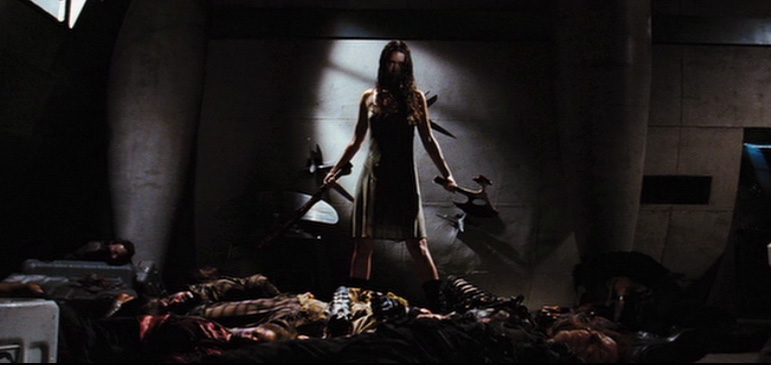
Serenity, on the other hand, challenges, alienates, disillusions, blames, and questions. There are evil monsters out there but we made them. They are us. Reflections of who we are and can become. Not bent on being set in an escapist ‘galaxy far, far away’, Serenity adds it’s bleak slant on realism by referring to ‘Earth that was’, suggesting humanity’s responsibility for the past tense title. The crux of science fiction has always been the controversy of humankind’s ability to negotiate the morals of natural law – a contest that we nearly always fail. Whedon’s film confronts this in true Sci-fi fashion by making it political as we discover that the government (who effectively suppressed the rebellion) is decidedly monstrous. And the Girl? River's single-handed slaughter of a room full of Reavers firmly splatters mysogeny with such post-fem swank that it makes Mal's bloody eye seem like a limp-wristed plea for sympathy. (although the eye thing was pretty cool, wasn't it?)
In a political climate where the critical teeth of Sci-fi should find the biggest appetite, we can applaud films that challenge, stir, and reflect. This is what the great science fiction writers (Wells, Verne, Bradbury, Dick, Huxley, Orwell, et al.) have all done. And, as dreary and low as our world often gets, we can rest assured that Serenity rises to the top.
Top List from SFX Magazine.
More on Serenity [Link]
Tagged under:
Film
Both films present a technologically varied universe that remains politically and socially stratified by oppressive governments (cynicism is an essential Sci-Fi trope). These films also apply many of the standard conventions of the Science Fiction genre as well as obvious characteristics from the Western.
 Star Wars: A New Hope idealizes the ‘American Dream’ as the rural everyman aspires to something bigger and better – heroic adventure, romanticism, stickin’ it to The Man, and (aside from ignorant incestuousness) getting the Girl. This is cool. This is fun. This is Greek Tragedy minus the Tragedy. This is opera. It appeals to our ‘everyday’ commonalities and fulfills our most ridiculous fantasies (swinging across a treacherous chasm in the arms of a lovely maiden? Oh yeah). It doesn’t insult us (except, sometimes, for the Girl – which is nothing new, so apparently it’s OK).
Serenity, on the other hand, challenges, alienates, disillusions, blames, and questions. There are evil monsters out there but we made them. They are us. Reflections of who we are and can become. Not bent on being set in an escapist ‘galaxy far, far away’, Serenity adds it’s bleak slant on realism by referring to ‘Earth that was’, suggesting humanity’s responsibility for the past tense title. The crux of science fiction has always been the controversy of humankind’s ability to negotiate the morals of natural law – a contest that we nearly always fail. Whedon’s film confronts this in true Sci-fi fashion by making it political as we discover that the government (who effectively suppressed the rebellion) is decidedly monstrous. And the Girl? River's single-handed slaughter of a room full of Reavers firmly splatters mysogeny with such post-fem swank that it makes Mal's bloody eye seem like a limp-wristed plea for sympathy. (although the eye thing was pretty cool, wasn't it?)
In a political climate where the critical teeth of Sci-fi should find the biggest appetite, we can applaud films that challenge, stir, and reflect. This is what the great science fiction writers (Wells, Verne, Bradbury, Dick, Huxley, Orwell, et al.) have all done. And, as dreary and low as our world often gets, we can rest assured that Serenity rises to the top.
Top List from SFX Magazine.
More on Serenity [Link]
Tagged under:
Film
Labels: Critical Studies, Film, Joss Whedon, Lists, Sci-fi, Serenity, SFX, Star Wars, Top Ten
posted by Mike at Monday, April 02, 2007
|
2 comments