Perspectives on Pop Culture and the Arts

Friday, September 28, 2007

Resident Evil Still Fighting Negative Waves


The reviews are in, opening week is passed and the critical consensus seems to be that Resident Evil: Extinction is a waste of time. This isn't a new conclusion for the Resident Evil franchise, but I can't help but wonder why the negative waves? It's Resident Evil. Not Citizen Kane. Should we honestly expect such brilliance from a show whose source material is a video game franchise? It's like expecting Pirates of the Caribbean to be of the same caliber as Fassbinder's BRD Trilogy.

Extinction doesn't even get the bogus criticism of being 'so bad it's good'. Perhaps people would be happier if Russell Mulcahy and Paul W.S. (not just one initial, but two!) Anderson had said Extinction was meant to be bad, or they were paying tribute to fellow bad movies. Heck, if Tarantino and Rodriguez can do Grindhouse and convince people it's great cinema, why can't Resident Evil exist as what it is: a pulp sci-fi/fantasy, fully equipped with poor lines and gun/machete-toting women who always look beautiful.

Extinction does have flaws, as do most shows like it. . . . or maybe just most shows. It would have been cool to see more of Vegas and spend more time in Vegas. I could have done without Ashanti. The ending was rushed and not explained very well. Well, then the show was ok. Not terrible. Not amazing. I got what I expected and was satisfied. Maybe that makes me just really easy to please, or just a sucker for pulp sci-fi.

Pulp shows like Extinction have their place and are fine in their own right. The issue with them is perhaps not so much the quality of these films as the expectations put on them. It seems they're supposed to stand up against shows they have no business being associated with. It could also be that the easy thing to do is trash shows like Resident Evil, Aeon Flux [2005], and The Island. Kinda how it's easier to praise stuff like The Departed, Saving Private Ryan, and Braveheart rather than be the guy ripping them apart.

Labels: , ,

Tuesday, May 01, 2007

Reshoots for Blade Runner's 25th?

Dark Horizons reports that Joanna Cassidy, who plays the famous replicant Zhora from the classic sci-fi film Blade Runner, has recently finished re-shooting scenes to be included in the film's upcoming 25th anniversary DVD boxed set.

From Cassidy's website:

Joanna has just finished re-shooting her scenes from the original BLADE RUNNER movie. Joanna is wearing her original outfit (which she kept over from the first production).
This could be really exciting - nearly as much as the fact that Cassidy still has that sweet outfit from 25 years ago! Apparently, director Ridley Scott has a great track record for extended/director's cut reissues - both Legend and Kingdom of Heaven received better reviews for the DVD release than they did for the theatrical. My only worry is that Blade Runner (one of my absolute favs, as previously mentioned) could suffer from the same conflated pretentious nostalgia that inspired George Lucas when re-releasing the Star Wars films (IV, V, VI) or the 30th anniversary release of Night of the Living Dead (not Romero's fault). The reshoots for both of these films, while I'm sure causing Lucas's beard to twitch and his beady eyes to start wiggin', made my childhood dreams distort in a pile of digitally induced CGI reflux. (For the record, 35mm black and white looks way better than miniDV with the color removed).

Lets hope that this release will be as cool as we all hope. And maybe if we're lucky, they'll shoot some more scenes with Edward James Olmos! Hey, if androids can dream, so can we!
Meh!


[Link] to the Dark Horizons article.


Labels: , , , , ,

Monday, April 02, 2007

Serenity Tops 'Best Sci-Fi' List

It comes as no real surprise (to me) that Joss Whedon's Serenity ousts Star Wars for the 'Best of Sci-Fi' as listed by SFX Magazine. In fact, I’m going to be pretentious enough to briefly tell you why I think the folks at SFX got it right.

Both films present a technologically varied universe that remains politically and socially stratified by oppressive governments (cynicism is an essential Sci-Fi trope). These films also apply many of the standard conventions of the Science Fiction genre as well as obvious characteristics from the Western.

Star Wars: A New Hope idealizes the ‘American Dream’ as the rural everyman aspires to something bigger and better – heroic adventure, romanticism, stickin’ it to The Man, and (aside from ignorant incestuousness) getting the Girl. This is cool. This is fun. This is Greek Tragedy minus the Tragedy. This is opera. It appeals to our ‘everyday’ commonalities and fulfills our most ridiculous fantasies (swinging across a treacherous chasm in the arms of a lovely maiden? Oh yeah). It doesn’t insult us (except, sometimes, for the Girl – which is nothing new, so apparently it’s OK).

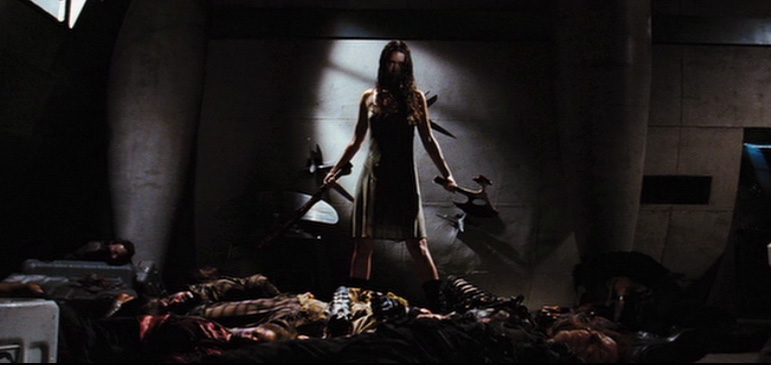
Serenity, on the other hand, challenges, alienates, disillusions, blames, and questions. There are evil monsters out there but we made them. They are us. Reflections of who we are and can become. Not bent on being set in an escapist ‘galaxy far, far away’, Serenity adds it’s bleak slant on realism by referring to ‘Earth that was’, suggesting humanity’s responsibility for the past tense title. The crux of science fiction has always been the controversy of humankind’s ability to negotiate the morals of natural law – a contest that we nearly always fail. Whedon’s film confronts this in true Sci-fi fashion by making it political as we discover that the government (who effectively suppressed the rebellion) is decidedly monstrous. And the Girl? River's single-handed slaughter of a room full of Reavers firmly splatters mysogeny with such post-fem swank that it makes Mal's bloody eye seem like a limp-wristed plea for sympathy. (although the eye thing was pretty cool, wasn't it?)

In a political climate where the critical teeth of Sci-fi should find the biggest appetite, we can applaud films that challenge, stir, and reflect. This is what the great science fiction writers (Wells, Verne, Bradbury, Dick, Huxley, Orwell, et al.) have all done. And, as dreary and low as our world often gets, we can rest assured that Serenity rises to the top.


Top List from SFX Magazine.

More on Serenity [Link]

Tagged under:

Labels: , , , , , , , ,

Thursday, February 22, 2007

The Day the Earth Stood Still... Seriously


The dirty word on the street is that one of the most reputable sci-fi flicks in film history will be mooshed through Hollywood's low-brow-remake cash extractor. Before you strain something at the thought of this heinous milkery, let me just say, well, ... "RUN!!! Run fast! Get your children, your pets, your ipods - and get awaaayyy!"

Instead of daft-looking army men bearing guns, there are now sinister-looking capitalists bearing studio clout. Our only hope rests on the endearingly silent and charismatic Gort coming down and melting their gold teeth and money clips or freezing all of the projectors on opening night.
"Gort. Klaatu, barada, nikto!"

And stop watching Ghost Rider.


[Link to the article]


Tagged under:
, , ,

Labels: , ,

Sunday, June 04, 2006

Slayage Conference Report - pt. II

What people consider sin, I consider human characterstics - Joss Whedon

[In Serenity] a world without sin is a world of death - Rhonda Wilcox

Another great panel that I attended was by the convenor of the conference, Rhonda Wilcox. The title of her paper was, '"I Do Not Hold to That": Joss Whedon and Original Sin' and I'll briefly outline some of the points she made.

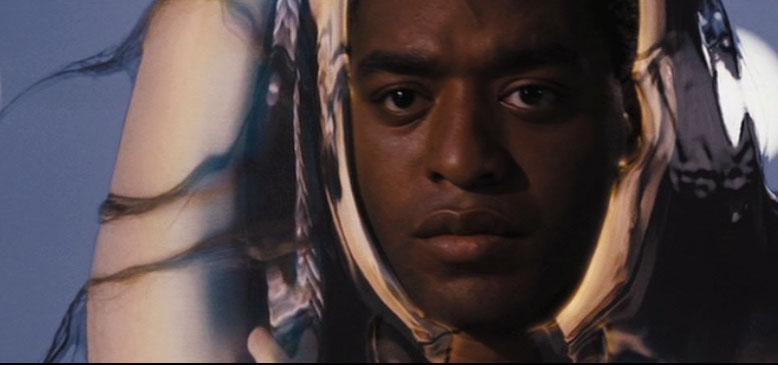
In Serenity, the character of River and the Operative are basically weapons (of mass destruction, as others have noted) and are both products of the Alliance's manipulation. The connection between the Operative/River and the Alliance's meddling is first illustrated in the opening flahsback-within-recording where the frame is paused while showing Simon rescuing his sister River from the Alliance. While focusing on the frozen picture of River and the Operative passes through the holographic image, his face replaces hers.


Wilcox made the point of how the film suggests that knowledge and consciousness can be seen as forms of original sin. The Operative asks each of his victims, 'Do you know what your sin is?', and according to his philosophy, the punishment for sin is death. This suggests an encouragement of choice and agency (which he himself hasn't even been allowed), but is undercut by how he physically disables them so that they make the sacrifice/restitution by falling to their death on a sword (his, not their own). It is also worth noting that the name of the Captain of the starship Serenity is Malcom ('Mal') Reynolds, and that the word 'mal' in Spanish means sin, bad, hurt, injury.

The Operative: Do you know what your sin is?

Capt. Malcom Reynolds: Aw, Hell, I'm a fan of all seven... but right now, I'm gonna have to go with Wrath.

The scene where River first goes berserk after viewing the video screen has allusions to Orson Welles's Citizen Kane, and 'Rosebud'. The close-up shot of River whispering 'Miranda' and the lips of Charles Foster Kane uttering 'Rosebud' both suggest a loss of innocence and downward spiral toward destruction - as is certainly seen when the Serenity crew discover the nature and origins of Miranda and associations with the Reavers. These two terms are also used as the focus of a mystery that drives the plot and challenges the viewer to decipher. The manipulation of the people on Miranda by the Alliance also suggests that compelling people toward Paradise only results in apathy and loss of humanity. By deconstructing Paradise, ala John Milton, Whedon's film is resistant to the notion of an 'ideal' society, favoring instead one that is governed by choice, but includes the inevitable flaws and mistakes resulting from personal agency. From this perspective it also seems to oppose the colonial visions of manifest destiny that is so often supported in science fiction.


**Note: This is an extremely truncated account of Wilcox's excellent talk. I'll keep my eyes out for an online version of it to link to in the future.

[Link to an abstract of Rhonda Wilcox's talk]


Tagged under:
, ,

Labels: , , , , , ,